
Start with the fibre
Long-staple cotton is spun from longer fibres, so the yarn is smoother, stronger and far less prone to pilling. That single fact explains most of the difference between linens that improve over years and linens that go rough after a season.
Our sheeting is 100% cotton sateen throughout, and the Vilanova collection is woven by hand to our specification at one of Northern Portugal's most respected mills. Where a fabric is made is a reasonable proxy for how carefully it is made.
- 100% long-staple cotton, single-ply yarn
- A named mill and a stated country of manufacture
- Be sceptical of blends sold as luxury
Weave, then thread count
The weave decides how linens feel. Sateen floats more yarn on the surface for a smooth hand and a soft, low sheen; percale is a plain, tighter weave that reads crisp, matte and cool.
Only then does thread count matter, and only within reason. Between roughly 300 and 500 cotton sheeting is smooth, breathable and durable; above that it gains weight and warmth rather than quality. Our two sateens sit at 300 and 400 for exactly that reason.
Finishing is where the money shows
Look at the borders, the hems and the closures. A hand-finished border sits flat and square; embroidery should be dense and even, with no puckering along the line. These are the details that survive a hundred washes or fail in ten.
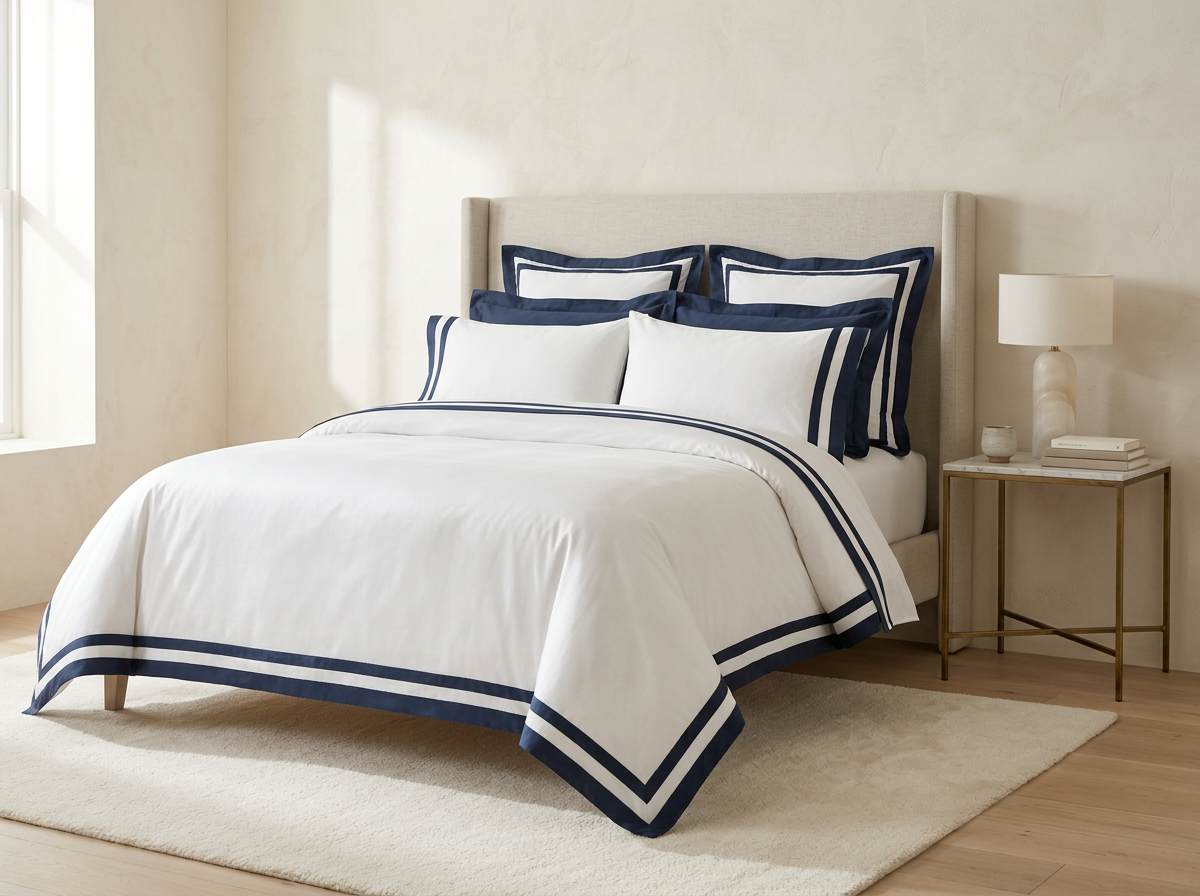
Both of our linen collections are defined by their borders - Windsor by subtle braided embroidery, Vilanova by dual-striped nautical lines - because that detail is the quietest way to make a white bed look considered.
- Flat, square borders with even stitching
- Deep hems that do not curl after laundering
- Colour applied so it stays even across every piece in the collection
Fit, and dressing the whole bed
Fine linens on the wrong size bed still look wrong. Size sheet sets to the mattress plus any pad or protector, and check pocket depth; size duvet covers to the comforter, not the mattress.
A finished bed usually needs four pieces: a sheet set, a duvet cover, pillowcases for sleeping and shams for the front layer. Keeping all four in one collection and colorway is what makes a bed look designed rather than assembled.
- Measure mattress depth including toppers and protectors
- Duvet cover follows the comforter size
- Two sets in rotation means the bed is never bare on laundry day
How to judge a fabric by hand
Hold the cloth up to light. An even, consistent grid means a well-controlled weave; blotchy density means uneven yarn. Then rub it between finger and thumb - good sateen feels dry and fluid, not slippery. A slick, waxy hand usually means a chemical finish that will wash away, taking the softness with it.
Finally, ask whether the piece can be laundered simply. Fine cotton should be washable at home: warm or cool water, mild detergent, no bleach, no fabric softener, tumble dried low and taken out faintly damp.